hybrid forms

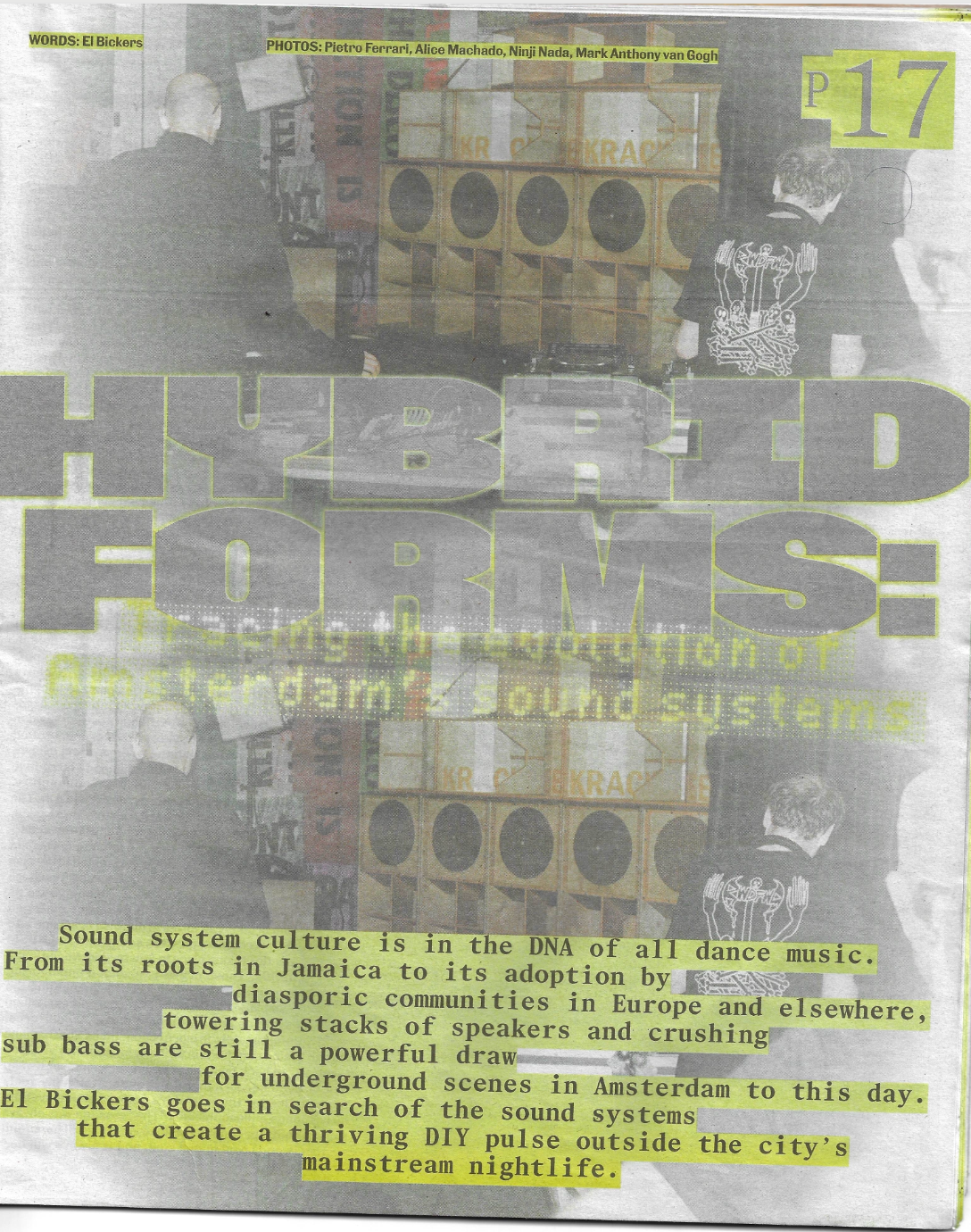
if you live in amsterdam, you probably started noticing the ade signs popping up all over the city, since early monday morning. you probably also noticed the twenty thousand copies of the ade zines scattered around the city ‘30 y ade: between the tracks vol. 04’.
ade isn’t an event that pos really celebrates, as it pushes most of the city to very consumerist behaviours and the fast pace feels like a whirlwind. however in this edition, journalist el bickers contacted several grassroots sound system crews to participate in the article ‘hybrid forms’. a conversation between the search of sound systems beyond mainstream nightlife. when pos was contacted, we took the opportunity to reflect on the possibilities of sound project, especially within the ecosystem we are part of alongside FRXCTOSE, covenant, audit audio, krack free and kantarion.
as the ade week begins, we would like to share the complete questionnaire used for this article and bring back attention to the origins and history of sound system culture and an open-source mentality. it is also an invitation for everyone attending ade events this week, to observe and listen closely. where is our culture investing energy, time and money? which voices and sounds are most present, and why?
although pos is not directly participating with ade, it is still heartwarming to witness how every single (grassroots) initiative in the city is offering a space to come together and dance. in these difficult times, we see people celebrating and exploring different ways of sharing space.
if you would like to join us this saturday for our event in collaboration with refuge worldwide, and for the community chillings on sunday for a slow recharge, you can find more information here. there will be food :)
thanks for listening
(part of) team platform monse alvarado-alvarez & lou touyarou.
hybrid forms
by el bickers,
What is pos and how does it relate to sound system culture in Amsterdam and beyond?
possibilities open studio (pos) is a community project. The studio space functions as an experimental collaborative space for creators and audience. At the core of this non-hierarchical organisation, there’s an explicit focus on multidisciplinary exchange, informed by explorations of sound as the connective thread. Within the space in Amsterdam-West, pos organises events, gatherings and workshops that aim to challenge visitors to broaden their musical and auditory horizons, while also questioning the ways we create culture together. During those three years of running an ongoing program of events and experiencing other spaces in and around Amsterdam, certain questions started to arise. What defines good sound? which voices do we want to amplify with this project? These questions organically led pos deeper into sound system culture, and its influence served as a standpoint that helped direct and evolve the pos vision. Sound isn’t just noise, but the choice to amplify certain voices, and an important tool to create empowerment, connection and unity. If we ignore the political and historical roots of sound-system culture, especially in view of the current state of the world, then adopting its aesthetics or practices risks becoming little more than a performative gesture rather than a genuine engagement with the traditions, histories, and communities from which it emerged - which we find plainly disrespectful to the people who made it available to us.
The knowledge and technology behind access to good sound continue to be gatekept, and celebration is only allowed when it serves the (economic) interests of a specific group of people. Understanding this history means that running a sound system becomes more than an act of pleasure; it becomes an act of care and commitment to what this culture was built on.
pos' journey to create real impact has, over time, led to the creation of possibilities of sound - an accessible speaker design and innovation research initiative which dives deeper into sound system culture and open-source knowledge sharing. Creators, thinkers and enthusiasts alike are involved in the exploration of sound engineering and the creative possibilities of DIY sound systems, to refine and deepen the sound experience.
How has custom sound system building become part of the ethos and identity of pos? Has it altered the way pos looks at community building?
From early on, the question of ‘what do people need?’ has been at the centre of all types of decision-making at pos. From aspects like sound and programming, all the way to community care. Custom sound system building, therefore, falls directly into pos’ ethos as it is nothing different from being able to follow up on people's needs within a certain space. Creating an infrastructure for this allows the creation of something unique and relevant for any community and the spaces they gather.
When focusing on only one standard speaker design, you lose the context in which the project takes place, missing out on a relevant part of the sonic dancefloor experience. Thinking about sound system building with modular and free-form characteristics as a clear starting point allows for the possibility of creating many different shapes of horns, which results in a wider range of options for all communities.
Customisation did not per se alter the way pos looks at community, but it definitely strengthened it and helped us open up creatively. The DIY mentality, which goes hand in hand with sound system culture, is emphasised through possibilities of sound and its multidisciplinary character. We are noticing right now that the project opened up collaboration paths for so many different people, from many different disciplines, allowing them to contribute to the sound system creation in ways both small and significant.
Community members are working on the technical side, but there are also people doing photography, making drawings, writing funding applications and much more. It even opened up new paths to think about the creation of new sounds and sound performances, all inspired by the interaction of the system, the space, and the community.
Before having the sound system, pos' way of bringing people together was by organising events, running a production, which often happened in the space. It is of course possible to recreate that in other spaces, but the interaction and ways of working make the experience quite different. However, bringing a sound system is like adding a strong pillar that you can build upon, that connects to the vibe and serves as a foundation. This allows for autonomy across different spaces.
How have you considered custom design and aesthetics part of the identity of sound system building?
With possibilities of sound, we look at custom design and aesthetics from the perspective of sound preferences and cultural identity, and not only the visual aspect of it. This is inspired by giving people the opportunity to play around with this acoustical idea of their sound preferences; you can create new ways of sharing certain sounds.
Customisation is an essential key needed to experiment with aesthetics in sound in a broader way. For example, a Colombian pico sound system looks and sounds very different from another type of system. It's really cool that a certain style of music and culture gets represented in this sound/aesthetic way too.
If we can experiment more with many perspectives and gain more knowledge about the aesthetics of sound, this opens up the exciting idea of possibilities for new styles to emerge.
How do you think this contributes to the future of sound system culture in Amsterdam and beyond?
By decentralising the (technical) knowledge around sound systems, it can potentially move more towards spaces that don't have a primary commercially consumer-driven approach. We like to contribute to Amsterdam sound system culture by shifting to community-run initiatives and making them more accessible. We attempt to achieve this by working together with people to create good sound systems on modest budgets, organise events independently, and leverage advanced tools without specialist training or large software licences. In other words, lower the barrier so people anywhere can start designing and building their own systems.
There is definitely a need in Amsterdam for more people to share their perspective, by focusing less on competition and more on collaboration and the understanding that everyone deserves to share their own perspective. The lack of space and resources is an issue that emerges directly from a capitalist system, strongly intertwined with the dancefloors in Amsterdam. It is common to have to pay 20-40 euros for entry tickets. There are rarely opportunities to go to a place where it’s comfortable to just be and share music through the system, for the people by the people, not by the people for the real estate owners. This directly conflicts with the values of sound system culture, where the point is to share music.
With the different projects at pos, the community has had the privilege of programming so many different sounds, and therefore been able to share so many different musical messages. Ranging from experimental or even minimalistic music to acoustic performances, the Latin American events of Carmela Collective and pos dub. There are many initiatives out there trying to make an effort, and with pos we try to add to this mission by lowering the barrier of accessible sound systems.
How do you think custom-built DIY sound systems are hybridising and altering the way people gather on dancefloors?
The customisation aspect is a way for us to engage on a deeper level with communities because it is tailored to an actual space. It gives users the possibility to prioritise their acoustic needs. We see in this a direct link to sound education. If you spend your whole life going out to spaces where a limited number of speaker brands and types are accessible, it is easy to forget that there are many choices that can be made. Listening to a DIY system can facilitate diverse listening experiences; therefore, it can shape the understanding of sound and of the culture surrounding it as well. Ultimately, music and the experiences that come with listening can function as a connecting bridge between cultures and even people's own perspectives.
An example of this is the collaborative project with Wonder Cabinet/ Radio Alhara. Their space presents significant acoustic challenges, particularly because it sits on the hillside, making sound leakage a major concern. Since they are located in Bethlehem, a densely populated city, excessive sound leakage would affect the surrounding neighbourhood; everyone around can hear it.. In order for the project to exist, there is therefore a clear need to direct the acoustical energy to one direction. This is a very specific challenge that requires a customised solution. Without such adaptations, these types of projects might not be allowed to exist. But knowing there are possibilities empowers people, enabling everyone to imagine and create cultural spaces that might otherwise seem out of reach.
That’s why we are pushing for this direction of custom sound with a focus on accessibility and open-source sharing. The hands-on workshop and knowledge-sharing sessions in the past and the ones upcoming allow other people to be able to spread the message and teach more people. We love this kind of spreading effect. When the knowledge is able to spread and reach community spaces, people can come together, pool the financial resources required to pull off these projects, which will always be a challenge. From there, people have the opportunity to create something special in a certain space.
Truly hybridising and transforming a dancefloor should emerge from the uniqueness of each community. That is why there are no standard answers or clear patterns. How do people gather on the dancefloor after a community builds its own sound system? This is for the reader to use their imagination.
What do you think centring the sound system can do for future clubbing communities and dancefloors in Amsterdam? Can you envisage new ways of dancefloor infrastructure?
There is an excessive amount of attention on the individual who is playing, in line with the commercial narrative of the music scene. To put it in a simplified way, people show up because a specific DJ is playing, which feeds into an individualistic mindset. People become celebrated personas and products, as long as they’re able to sell tickets. This often means arranging so people stand right in front of a DJ, sometimes even placing them on a platform elevated above the crowd. To counter this idea, the focus should fall on the actual sound, and therefore on the sound system that represents a community and is created by many.
But the real answer is that there is not really an infrastructure formula, and it is often very abstract. Every space requires different ways of thinking in order to create a coherent dancefloor. So for us, this answer is also space and time dependant, and not necessarily straightforward. We always try to experiment with different setups. On one occasion, we placed the DJ booth in the kitchen. There are playfulness and surprise elements that can inspire organisers to tap into the creativity and the mysticism of sharing music. Even if people are used to a certain space, it's up to the organisers to come up with different infrastructures and create new dynamics in how people interact with each other, the sound and the space. Lack of (financial) resources does not equate to lack of creativity; you can do many things, and we think that that's what's actually interesting. Creating a moment which makes you think “you had to be there to understand” emerges from collaborating and having a clear intention.
if you would like to join the conversation, please contact us at platform@possibilitiesopenstudio.com, or get involved with the sound project by writing to sound@possibilitiesopenstudio.com
you can also check out the zine’s article by downloading it through this link.
if it doesn’t work, please contact us :)